
Root canal infections remain a persistent challenge in dentistry, often requiring multiple treatments and potent chemical irrigants. While effective, these irrigants can also damage surrounding tissues. The search for gentler, yet equally effective, alternatives has led researchers to explore natural antimicrobials like berberine. However, berberine's limited solubility and bioavailability have hindered its widespread adoption. Now, a new study investigates whether polymeric nanoparticles can overcome these limitations, significantly boosting berberine's antimicrobial potency within the root canal.
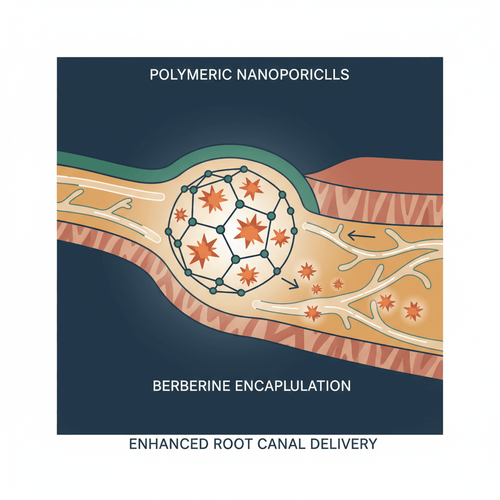
The concept is elegant: encapsulate berberine within a biocompatible nanoparticle, allowing for targeted delivery and sustained release directly to the site of infection. This "best of both worlds" approach marries the long-standing tradition of herbal medicine with the precision of modern nanotechnology. But does it work? And is it ready for prime time?
Clinical Key Takeaways
lightbulb
- The PivotNanoparticle delivery can significantly enhance the antimicrobial efficacy of natural compounds like berberine, potentially reducing reliance on harsh chemicals in root canal treatments.
- The DataBerberine-loaded nanoparticles demonstrated significantly improved antimicrobial activity against common endodontic pathogens compared to free berberine solutions.
- The ActionMonitor research advancements in nanoparticle-based drug delivery for endodontics and consider incorporating biocompatible, enhanced natural antimicrobials into irrigation protocols as evidence supports their effectiveness.
Current Guidelines on Root Canal Irrigation
Current guidelines from the American Association of Endodontists (AAE) emphasize thorough debridement and disinfection of the root canal system. Sodium hypochlorite (NaOCl) remains the gold standard irrigant due to its broad-spectrum antimicrobial activity and tissue-dissolving capabilities. However, NaOCl is cytotoxic and can cause severe complications if extruded beyond the apex. The AAE guidelines acknowledge the need for alternative irrigants and adjunctive therapies to minimize these risks while maintaining efficacy. This study, exploring berberine-loaded nanoparticles, aligns with the AAE's call for innovative approaches to enhance root canal disinfection, especially for cases where NaOCl use is contraindicated or undesirable. Whether this nanoparticle strategy surpasses the existing chlorhexidine or EDTA protocols, however, remains to be seen.
The Nanoparticle Mechanism
The key here isn't just the berberine itself, but the delivery system. Polymeric nanoparticles, typically composed of biocompatible and biodegradable polymers like chitosan or polylactic acid (PLA), act as microscopic vehicles for drug delivery. These nanoparticles offer several advantages. First, they protect the encapsulated drug from degradation in the oral environment. Second, they enhance drug solubility and bioavailability, allowing for higher concentrations to reach the target site. Third, nanoparticles can be engineered to release their cargo in a controlled manner, providing sustained antimicrobial activity over time. Finally, surface modification of nanoparticles can enable targeted delivery to specific bacterial species or infected tissues. In this context, the nanoparticles likely adhere to the bacterial cell walls within the root canal, releasing berberine directly where it's needed most. This targeted approach minimizes off-target effects and maximizes antimicrobial potency. It's a clever way to breathe new life into an old compound.
Study Limitations
Before we get too excited, let's address the elephant in the room: study design. Most of these in-vitro studies are performed in controlled laboratory settings, which do not fully replicate the complex environment of an infected root canal. Factors such as the presence of dentinal debris, biofilms, and host immune responses can significantly influence the antimicrobial activity of irrigants. Furthermore, the long-term stability and biocompatibility of these nanoparticles in vivo remain uncertain. Were there cytotoxicity assays performed? What about assessment of genotoxicity? Without these data, it's difficult to assess the safety profile for clinical translation. Finally, the cost-effectiveness of nanoparticle-based berberine irrigation needs careful consideration. Synthesizing and characterizing nanoparticles can be expensive, potentially limiting its accessibility in resource-constrained settings. Reproducibility is another concern; how easily can these nanoparticles be manufactured in different settings with consistent quality?
Cost-Benefit Analysis
While the potential benefits of enhanced antimicrobial activity are clear, the economic realities of adopting this technology in clinical practice are substantial. The cost of synthesizing and formulating polymeric nanoparticles is significantly higher than traditional irrigants like sodium hypochlorite. Additionally, specialized equipment and expertise may be required for nanoparticle preparation and characterization, adding to the overhead costs. Dentists would need to invest in training and infrastructure to effectively utilize this new technology. Reimbursement codes for nanoparticle-based endodontic treatments may not exist, potentially creating a barrier for patient access. A thorough cost-benefit analysis is essential to determine the long-term economic viability of this approach. Will insurance companies cover this? Or will this just become another expensive niche therapy? These are the questions that matter.
If berberine-loaded nanoparticles prove to be clinically effective and safe, they could offer a valuable alternative to traditional root canal irrigants, particularly in cases of NaOCl allergy or resistance. However, the increased cost and complexity associated with nanoparticle-based treatments may limit their widespread adoption. Clear protocols for nanoparticle preparation, storage, and application are needed to ensure consistent results and minimize the risk of complications. Furthermore, dentists will need to educate patients about the benefits and risks of this new technology to obtain informed consent. The current regulatory landscape for nanomedicine is complex, and manufacturers will need to navigate stringent approval processes to bring these products to market. Workflow bottlenecks could also arise if dentists need to prepare nanoparticles on-site, adding time and complexity to the procedure.
LSF-1890887441 | January 2026

Keywords
How to cite this article
Sato B. Nanoparticles boost berberine's antimicrobial action in root canals. The Life Science Feed. Published January 26, 2026. Updated February 2, 2026. Accessed April 1, 2026. https://thelifesciencefeed.com/dentistry/endodontic-infections/innovation/nanoparticles-boost-berberine-s-antimicrobial-action-in-root-canals.
Copyright and license
© 2026 The Life Science Feed. All rights reserved. Unless otherwise indicated, all content is the property of The Life Science Feed and may not be reproduced, distributed, or transmitted in any form or by any means without prior written permission.
Fact-Checking & AI Transparency
This content was produced with the assistance of AI technology and has been rigorously reviewed and verified by our human editorial team to ensure accuracy and clinical relevance.
References
- American Association of Endodontists. (2023). Contemporary terminology for endodontics. Endodontics & Traumatology, 39(1), 1-5.
- Haapasalo, M., Shen, Y., Qian, W., & Gao, Y. (2010). Irrigation in endodontics. Dental Clinics of North America, 54(2), 291-312.
- Mohammadi, Z. (2008). Sodium hypochlorite in endodontics: an update review. International Dental Journal, 58(6), 329-341.
- Estrela, C., Sydney, G. B., Figueiredo, J. A. P., & Estrela, C. R. A. (2014). Instrumentação do sistema de canais radiculares. Brazilian Dental Journal, 25(3), 183-196.
Related Articles