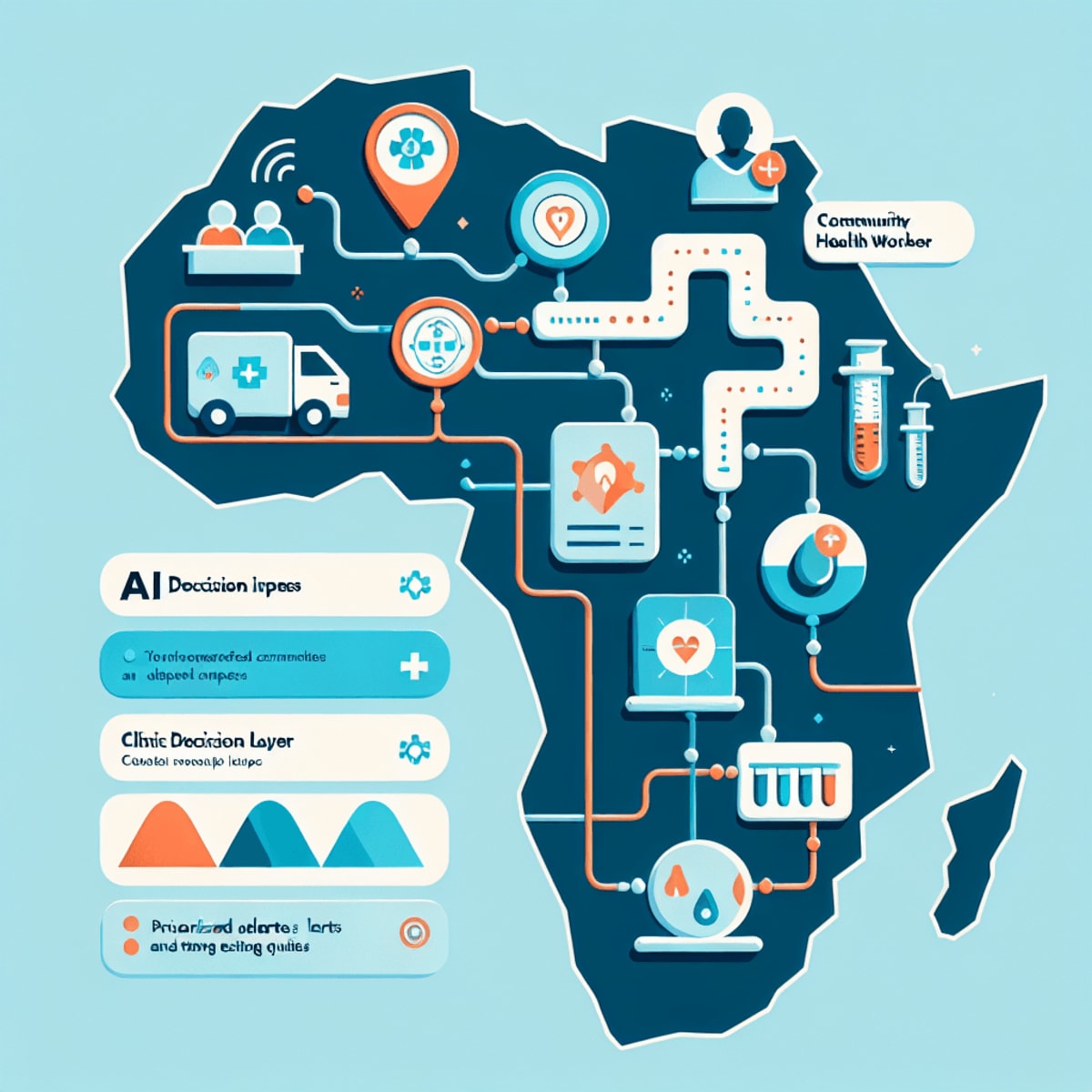
Public health teams facing recurrent Mpox events in Africa need tools that work under real-world constraints: limited laboratory capacity, uneven connectivity, and variable data quality. Integrating artificial intelligence into Integrated Disease Surveillance and Response (IDSR) offers a way to turn diverse, noisy signals into timely, operational decisions. When thoughtfully implemented, AI can help prioritize who gets tested, which alerts warrant field investigation, and how to allocate community resources without overburdening frontline staff.
This article distills practical actions for IDSR programs to embed AI across the surveillance-to-response continuum, focusing on alert thresholds, triage, contact tracing support, laboratory prioritization, and community data capture. It emphasizes governance, equity, and workforce readiness, and outlines validation and monitoring guardrails for safe and sustainable scale-up. For source details, see PubMed 41005719.
Operational AI for Mpox surveillance in IDSR workflows
Mpox is a re-emerging zoonosis with heterogeneous transmission patterns across urban and rural contexts. In many African settings, surveillance depends on IDSR reporting, clinical suspicion, and finite laboratory capacity. AI can elevate this foundation by converting raw signals into tiered, actionable recommendations for alerts, testing, triage, and community response. On the surveillance side, models can sift signals for anomaly detection and early clustering; on the response side, they can support investigators with risk scores and contact strategies. To keep workload manageable, the system should recommend the smallest action that meaningfully reduces onward transmission.
From signals to alerts
Most ministries already collect multiple data streams that are underused for real-time detection. A unified signal layer can combine IDSR case counts, syndromic tallies, clinician free text, CHW forms, pharmacy sales, and even vetted rumor logs into a calibrated anomaly detector. The first meaningful mention of Mpox in a district report should not trigger a blanket alarm; instead, a tuned threshold can escalate only when corroborating signals rise. A practical default is to require two independent indicators exceeding their baselines before generating a field alert, with configurable sensitivity during known surges. Strong versioning and governance ensure that threshold changes are transparent and reversible if they generate too many false positives.
Syndromic triage and risk stratification
At primary care and community touchpoints, brief symptom checklists and exposure histories can feed a lightweight triage model to guide isolation advice and testing priority. A structured approach to risk stratification helps clinicians decide who needs PCR, who merits presumptive isolation, and who can be safely observed. To avoid overfitting to scarce positives, start with interpretable rules and gradually add machine learning features validated against prospectively collected outcomes. Model outputs should be presented as risk categories with clear next-step actions rather than opaque scores. When risk is uncertain, the system should default to clinician judgment and provide a concise rationale for why uncertainty is high.
Prioritizing laboratory testing
Laboratories remain a bottleneck in many regions, making selective testing critical. A queueing tool can rank specimens by predicted yield and public health impact, balancing equity and outbreak control. Inputs include symptom duration, exposure risk, community incidence, and transport turnaround. If the model predicts that a particular specimen is highly likely to confirm an emerging cluster, it can be flagged for rapid processing without sidelining sentinel surveillance. This process benefits from weekly governance review to ensure priority rules do not inadvertently disadvantage remote or underserved populations.
Contact tracing augmentation
Contact tracing often falters when caseloads spike or contact networks are diffuse. AI can suggest a starting list of high-yield contacts by integrating exposure setting, contact duration, and network proximity. In practice, the goal is not to enumerate every contact but to find those most likely to seed new chains. Augmenting contact tracing with simple risk tiers and suggested follow-up intervals can conserve team bandwidth. Field teams should be able to override model suggestions quickly and feed corrections back to improve performance without increasing data entry burden.
Calibrated alert thresholds
Thresholds should tune sensitivity to the season, context, and data completeness. In low-incidence periods, a lower detection bar can help catch sporadic introductions early. During known outbreaks, tighter thresholds reduce unnecessary alerts and keep focus on high-probability clusters. Calibration should be data-driven using rolling baselines and conservative priors to avoid overreacting to noise. When data quality degrades, the system should signal uncertainty explicitly and recommend manual review rather than escalate automatically.
Building reliable data pipelines and decision support
Operational AI hinges on dependable capture of frontline observations and careful conversion of unstructured content into analyzable events. Rather than building new apps, retrofit existing CHW tools with the few additional fields that drive the largest decisions. Standardize case definitions and minimum datasets across programs to avoid branching logic that confuses users. Where connections are intermittent, allow fully offline capture with small, secure payloads synced opportunistically. Decision layers should run close to where data are generated so that alerts and recommendations return to teams promptly.
Data architecture and governance
A minimal shared schema for person, event, specimen, and location enables consistent joins across systems. Data lineage tags should track who entered data, when, and on which device to support quality audits. The architecture should tolerate missingness by design, substituting neighborhood or district-level proxies until more granular data arrive. Routine dashboards must show data completeness alongside trends so that users interpret risk with the right caveats. Governance bodies should approve data sources, retention periods, and access tiers to prevent mission creep and protect trust.
Text and voice to structured data
Clinician notes, hotline calls, and field narratives capture rich context that structured forms miss. Lightweight natural language processing can extract symptoms, travel, and exposure settings from short texts or transcripts, then map them to controlled vocabularies. On-device models can transcribe and codify brief voice notes where typing is impractical, minimizing friction for busy staff. Confidence thresholds should be conservative, prompting human review when extraction is uncertain or contradictory. Over time, local language and slang dictionaries will improve recall without sacrificing precision.
Geospatial risk mapping
Spatial clustering helps direct scarce field teams to where they can avert the most transmission. Combining case locations, mobility corridors, and health facility catchments, basic geospatial modeling can estimate neighborhood risk and highlight potential spread corridors. Outputs should be simple choropleths and rank-ordered lists of small areas to visit, not complex maps that require specialized training. Models should acknowledge sparse or biased geocoding by using coarser spatial units where necessary. When live mobility information is unavailable, historical patterns plus market-day schedules can still improve targeting.
Model validation and drift monitoring
Every model needs a pre-specified plan for internal validation, prospective evaluation, and monitoring for drift. Hold-out evaluation should mirror intended use, such as predicting positive PCR among persons under investigation rather than generic case detection. Weekly drift checks can compare feature distributions and calibration curves to baseline and flag retraining needs. Simple shadow-mode deployments let teams assess recommendations without altering practice until performance is proven. All metrics should be intelligible to non-specialists, prioritizing sensitivity, positive predictive value, and turnaround impact over exotic scores.
Human-in-the-loop decision support
AI should assist, not replace, public health judgment. The first mention of decision support underscores that recommendations must be explainable in one or two sentences and paired with a clear next step. Interfaces should show why an alert fired and allow quick dismissal with a reason, creating a feedback loop for improvement. Where feasible, in-app checklists can standardize field investigations and reduce variability across teams. Formal sign-off policies help embed models into routine operations without eroding clinician or epidemiologist autonomy.
Governance, equity, and the implementation roadmap
Trust and accountability underpin sustainable deployment. Ministries and implementing partners should articulate a governance framework that specifies goals, data uses, roles, and escalation pathways for concerns. A simple risk registry can document model purpose, inputs, outputs, and known failure modes. Equity reviews should check that algorithms do not preferentially miss rural or marginalized communities. Procurement and contracting should require vendors to deliver documentation, reproducible models, and a handover plan to local teams.
Privacy and federated learning
Given sensitivity of case and contact information, privacy-preserving strategies are essential. Where centralized pooling is not feasible, federated learning allows model training across sites without moving raw data. Techniques like secure aggregation and differential privacy can reduce re-identification risks while preserving utility for surveillance tasks. For operational simplicity, start with coarse-grained protections such as k-anonymity at district level and graduate to stronger methods as capacity grows. Privacy reviews should be iterative, reflecting changes in model scope or data sources.
Bias, fairness, and equity
Bias can creep in through who seeks care, how cases are recorded, and which regions report reliably. Routine fairness audits can compare sensitivity and false negative rates across facility types and geographies. Where disparities emerge, options include reweighting training data, adding equity constraints, or creating stratified models. Importantly, equity is not only statistical; it is operational. Outreach planning should ensure that small, remote communities receive targeted support even when models prioritize urban hotspots.
Capacity building and procurement
Long-term value depends on local capability to maintain and adapt tools. Training should cover basic data literacy for frontline staff, model interpretation for epidemiologists, and MLOps basics for informatics teams. Procurement language can mandate open formats, containerized deployments, and clear performance and uptime commitments. Avoid lock-in by requiring access to model artifacts, training data schemas, and retraining scripts. Align incentives so vendors and partners are measured on adoption, user satisfaction, and public health impact, not only feature delivery.
Phased implementation roadmap
A phased plan helps teams deliver early wins while building toward scale. Phase 1 focuses on data readiness, baseline dashboards, and a conservative alerting rule that reduces noise without new hardware. Phase 2 adds targeted models for testing prioritization and clinic triage, with strong human oversight. Phase 3 extends to geospatial targeting and augmented contact tracing, coupled with routine validation and equity audits. Each phase should include a rollback plan, clear success criteria, and a communications strategy for stakeholders.
Limitations and research needs
AI will not fix persistent underreporting, stockouts, or workforce shortages by itself. Data shifts during outbreaks can degrade calibrated thresholds and confuse anomaly detectors. Prospective studies are needed to quantify how much AI improves timeliness, positive predictive value, and field investigation yield under varied constraints. Comparative evaluations of federated versus centralized training would help ministries choose privacy options that fit their contexts. Further details and conceptual guidance are discussed in PubMed 41005719, which complements these operational recommendations.
In sum, integrating AI into IDSR for Mpox is less about cutting-edge algorithms and more about disciplined, equitable operations. Start with the smallest set of fields that change decisions, return recommendations within existing workflows, and monitor performance with transparent metrics. Use privacy-preserving approaches proportionate to risk, and invest in local capability so models adapt as the epidemiology evolves. With these guardrails, AI can help ministries convert scattered signals into faster, fairer action where it matters most.
LSF-1210672010 | October 2025

How to cite this article
Team E. Ai integration for mpox surveillance in african health systems. The Life Science Feed. Published October 23, 2025. Updated October 23, 2025. Accessed April 2, 2026. https://thelifesciencefeed.com/general-practice/preventive-health-services/practice/ai-integration-for-mpox-surveillance-in-african-health-systems.
Copyright and license
© 2026 The Life Science Feed. All rights reserved. Unless otherwise indicated, all content is the property of The Life Science Feed and may not be reproduced, distributed, or transmitted in any form or by any means without prior written permission.
Fact-Checking & AI Transparency
This content was produced with the assistance of AI technology and has been rigorously reviewed and verified by our human editorial team to ensure accuracy and clinical relevance.
References
- AI-driven strategies for enhancing Mpox surveillance and response in Africa. https://pubmed.ncbi.nlm.nih.gov/41005719/.
Related Articles
