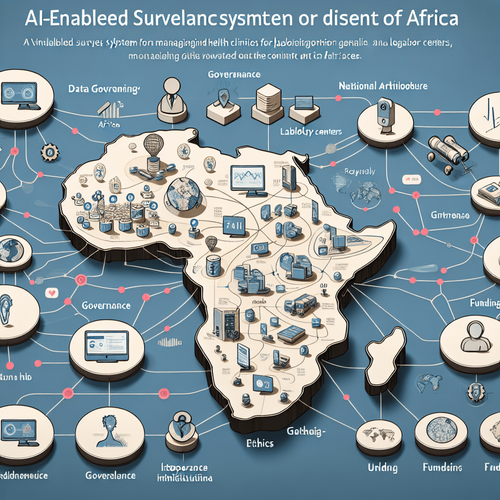
Mpox surveillance and response in Africa face persistent blind spots driven by underreporting, uneven laboratory capacity, and delayed signal integration across health systems. AI-enabled digital epidemiology offers a pathway to reduce latency from signal to action by extracting patterns from clinical, laboratory, mobility, and open-source data. Yet the same tools can amplify bias, obscure accountability, and widen inequities if deployment outpaces governance.
This analysis synthesizes emerging approaches for AI-augmented detection, situational awareness, and response coordination in low- and middle-income settings, drawing on insights from a recent review of Mpox surveillance innovation (PubMed). We outline practical enablers, guardrails, and metrics for real-world implementation, emphasizing fairness, data minimization, and local validation. The goal is to translate technical promise into durable public health capability that is context-aware and ethically grounded.
AI opportunities for Mpox surveillance in LMICs
Mpox transmission dynamics in Africa are shaped by multisectoral factors, including mobility, animal reservoirs, and care-seeking behavior, which strain conventional surveillance. AI can extend coverage by integrating routine reports with open-source and environmental streams in a unified digital epidemiology workflow. Early detection benefits from automated signal triage across facility logs, helplines, and media, including syndromic surveillance that flags rash, fever, or lymphadenopathy clusters. Methods spanning machine learning and natural language processing can prioritize plausible events, reducing noise while preserving sensitivity for field verification.
Data streams and signal detection
In practice, automated ingestion can harmonize facility line lists, event-based media monitoring, and platform reports from community health workers. Entity recognition and topic classification enable triage of Mpox-relevant signals without manual screening at scale. Location inference supports geospatial modeling of putative clusters at the district level despite incomplete addresses. To manage volatility, robust outlier detection and calibration with gold-standard lab confirmations reduce spurious alerts while maintaining time-to-detection advantages.
Temporal models that incorporate reporting delays can transform raw signals into estimators of current incidence. Epidemic state estimation benefits from epidemic forecasting approaches that blend mechanistic intuition with flexible statistical learning. When high-frequency data are sparse, simple hierarchical structures outperform overly complex architectures by pooling strength across similar districts. Continuous backfill adjustment prevents premature conclusions from early incomplete case reports.
From signals to situational awareness
Translating alerts into action requires combining risk gradients with operational context. Mpox risk maps can layer mobility patterns, health facility access, and historical incidence to guide testing deployment and contact tracing. Short-horizon estimates benefit from Bayesian nowcasting, which explicitly models reporting delays and uncertainty. Decision dashboards should expose credible intervals and missingness patterns, enabling managers to weigh resource trade-offs under uncertainty rather than relying on point estimates alone.
Downstream response can be prioritized by overlaying health workforce distribution, cold chain logistics, and personal protective equipment stock levels. Model outputs should be framed as advisory signals that prompt targeted verification, not as replacements for field epidemiology. Where lab capacity is constrained, pooled testing algorithms and adaptive sampling can increase yield per test. Embedding these tools into routine operations reduces reliance on surge-only deployments that fade after emergency funding cycles.
Augmenting field epidemiology
AI should be designed to amplify, not automate away, the work of surveillance officers. Mobile decision support can prefill case investigation forms, surface similar past events, and suggest contacts at highest risk. Geo-tagged tasks can optimize routing for sample pickup and home follow-up, translating model inferences into practical itineraries. Importantly, officers must retain control over triage thresholds and escalation rules to align with local priorities and norms.
Integrating community-generated data requires careful curation to prevent rumor propagation. Lightweight verification checklists can gate model-triggered alerts before resource-intensive deployments. Feedback loops that capture field outcomes should inform model retraining schedules and error analysis. Over time, this creates a living system where algorithm and practice coevolve toward better coverage, timeliness, and reliability.
Data quality, bias, and governance in digital epidemiology
Data scarcity and skew are central risks in Mpox modeling across heterogeneous African settings. Under-ascertainment is not random; it tracks facility density, stigma, and transport barriers, biasing model targets and features. Addressing such risks demands technical and institutional responses that encompass data governance, privacy, and validation. The review of Mpox surveillance innovation (PubMed) underscores that accurate models are inseparable from trustworthy data stewardship.
Addressing gaps and skew in training data
Label scarcity arises when laboratory confirmation is limited or delayed, and when clinical presentations overlap with other dermatoses. Semi-supervised learning and weak labels from clinical notes can bootstrap classifiers, but require continual auditing for drift. Spatial pooling can reduce variance yet risks masking hot spots in pastoral or peri-urban settings. Where possible, targeted data collection should focus on underrepresented districts and groups to rebalance the training distribution.
Bias mitigation starts with explicit measurement. Stratified performance reporting by district, facility tier, age, and sex can reveal disparities that global accuracy obscures. Sensitivity analysis to missingness mechanisms allows planners to see how conclusions change under plausible reporting scenarios. When feasible, active learning can prioritize human review of cases that are both uncertain and influential for decision thresholds, improving equity where it matters most.
Privacy, consent, and data-sharing models
Privacy is a prerequisite for public trust, particularly when combining clinical data with mobility or media signals. Minimization strategies limit collection to what is necessary for surveillance objectives and retention to the period of operational need. Techniques such as differential privacy can protect aggregates used for dashboards and research. For cross-border collaboration, federated learning enables model training across jurisdictions without moving raw data, mitigating legal and ethical constraints.
Consent pathways should be fit-for-purpose and transparent, distinguishing public health operations from research, with proportional safeguards for each. Clear roles and agreements reduce ambiguity over who can access what, when, and why. Governance boards that include public representatives can review high-impact deployments and adjudicate trade-offs. Integrating veterinary and environmental data under a One Health lens further complicates consent practices and underscores the need for interoperable, tiered access control.
Fairness metrics and local validation
Equity cannot be inferred from overall calibration alone. Fairness-aware evaluation should report error rates across strata that matter for Mpox, such as remote districts, mobile populations, and children. Model selection should reflect ethical preferences, for instance favoring recall in underserved areas even at the cost of more false positives, if resources allow. Publishing evaluation protocols and error taxonomies helps align stakeholder expectations and reduces performative transparency.
Local validation is not a one-off exercise. Prospective pilots with embedded monitoring can test whether anticipated gains materialize in workflow, not only in retrospective AUC. Triangulation with independent data sources, including event investigations and serology where available, can surface systematic blind spots. When models underperform for particular communities, governance should authorize context-specific thresholds or alternative decision rules rather than forcing uniformity.
Building readiness: infrastructure, workforce, and evaluation
Turning prototypes into durable capability requires attention to platforms, procurement, and human factors. Data pipelines must support standards-based exchange to achieve interoperability across national systems, laboratories, and community programs. Lean architectures that leverage existing infrastructure reduce maintenance burden and vendor lock-in. Implementation plans should specify ownership, uptime, and escalation paths so that analytics do not become orphaned during leadership transitions.
Platforms, interoperability, and procurement
Platform decisions shape long-term costs and flexibility. Modular components for ingestion, storage, analytics, and visualization allow teams to swap elements without system-wide rewrites. Open data formats and APIs simplify integration with case management tools and laboratory information systems. Procurement should reward performance and openness, not only feature lists, with service-level agreements linked to public health outcomes and clear exit options.
Where specialized data are needed, such as environmental signals, integration can extend to sentinel sites and wastewater networks. Emerging wastewater surveillance can complement clinical reporting by indicating cryptic transmission, although site selection and assay validity remain context specific. For rural districts, offline-first design and asynchronous synchronization are essential to withstand power and connectivity interruptions. Cloud footprints should be sized to projected workloads and budget envelopes, avoiding sprawl that cannot be sustained after pilot funding.
Capacity building and collaborative networks
Technology is only as effective as the workforce that uses it. Cross-functional teams that include epidemiologists, data engineers, and community liaisons can translate signals into operations. Training should cover data literacy, model interpretation, and escalation procedures, with case-based scenarios tailored to Mpox. Regional centers of excellence can provide help desks, code repositories, and shared benchmark datasets to reduce duplicated effort.
Partnerships with universities and national public health institutes can institutionalize pipelines for talent and research translation. When expertise is scarce, shared services can host core analytics while countries retain data ownership and decision rights. Public participation, through community advisory groups and feedback channels, strengthens legitimacy and helps detect harms early. Incentives for field staff to use and critique tools close the loop between analytics and practice.
Evaluation, accountability, and sustainability
Routine evaluation should track operational metrics that matter, such as time from alert to investigation, tests per detected case, and stockout avoidance. Pre-specified key performance indicators allow apples-to-apples comparisons across districts and time. Cost tracking, including staff time and connectivity, clarifies the real price of timeliness and scale. Public reporting of aggregate performance, coupled with learning reviews, sustains accountability beyond emergency cycles.
Sustainability hinges on aligning incentives and budgets with core public health functions. Donor-funded pilots should plan transition to domestic financing from the outset, with milestone-based handoffs. Documentation and open artifacts reduce vendor dependence and enable peer review. Above all, governance should empower local decision makers to adapt tools to evolving epidemiology and community norms, ensuring that Mpox surveillance becomes progressively more anticipatory, equitable, and resilient.
In sum, AI can help close surveillance gaps for Mpox in Africa by systematizing weak signals, quantifying uncertainty, and guiding scarce resources to where they matter most. The value will accrue only if programs confront data scarcity and bias head-on, apply proportionate privacy, and measure equity explicitly. A practical path forward blends modest, robust models with strong governance, interoperable platforms, and empowered field teams. With these enablers in place, AI becomes a durable public health capability rather than a transient experiment.
LSF-3865107771 | October 2025

How to cite this article
Team E. Ai-enabled mpox surveillance in africa: enablers and risks. The Life Science Feed. Published November 11, 2025. Updated November 11, 2025. Accessed April 2, 2026. https://thelifesciencefeed.com/healthcare-sys-and-biz/health-policy/insights/ai-enabled-mpox-surveillance-in-africa-enablers-and-risks.
Copyright and license
© 2026 The Life Science Feed. All rights reserved. Unless otherwise indicated, all content is the property of The Life Science Feed and may not be reproduced, distributed, or transmitted in any form or by any means without prior written permission.
Fact-Checking & AI Transparency
This content was produced with the assistance of AI technology and has been rigorously reviewed and verified by our human editorial team to ensure accuracy and clinical relevance.
References
- AI-driven strategies for enhancing Mpox surveillance and response in Africa. PubMed. https://pubmed.ncbi.nlm.nih.gov/41005719/.